Media Release - October 7, 2026
Nova Scotia leads Canada with stronger child passenger safety laws
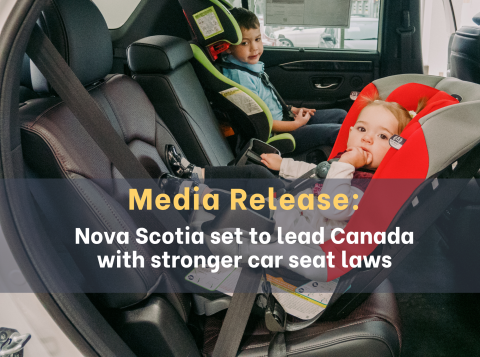
Halifax, NS - Child Safety Link, the children’s injury prevention program of IWK Health, applauds Nova Scotia for strengthening child passenger safety laws that will require children to remain in a rear-facing car seat until at least age two and remain in a harnessed car seat until a minimum age of four.
These changes will make Nova Scotia the first province or territory in Canada to establish these important age-based minimums in law.
The amendments will raise the minimum protections for young children travelling in vehicles, addressing two important areas that Child Safety Link and national injury prevention partners have recommended strengthening.
“We are very pleased that Nova Scotia is taking a leadership role in Canada by adding clear, age-based protections into law,” says Dr. Krista Jangaard, President and CEO of IWK Health. “These are meaningful changes that will better protect our youngest passengers, and we commend the Province for taking action.”
Child Safety Link would like to emphasize the following:
Motor vehicle collisions continue to be a leading cause of death for children in Canada. Car seats save lives.
All children should be correctly buckled in the right car seat or booster seat on every ride, in every vehicle.- There is a greater risk of injury when a child rides forward-facing before age two or in a booster seat before age four.
- Most families can follow these new requirements using the seats they already own.
Car seat design and engineering have evolved significantly over the last 15 years, allowing children to remain rear-facing and harnessed for longer. The new requirements better align the law with both current evidence and advances in car seat design.
- A 2024 research study led by Dalhousie University and Child Safety Link assessed 1005 child passengers in Nova Scotia, and found that 81% of car seats and booster seats had at least one error that could affect safety.
“Strengthening the law is an important step, but our research shows that families also need clear education, knowledgeable support, and access to safe seats,” says Katherine Hutka, Health Promotion Specialist with Child Safety Link, the injury prevention program at IWK Health. “The goal is not only for families to understand the new requirements, but to be able to use and install their child’s seat correctly to prevent injury.”
Child Safety Link has supported Nova Scotia families and the professionals who work with them for more than two decades through education, resources, professional training and direct support. As the new requirements are implemented, Child Safety Link encourages investment in public education, professional capacity and equitable access to child passenger safety support to help ensure families can understand and follow the new requirements correctly.
Child Safety Link continues to recommend that children remain in each stage for as long as they safely fit within the height and weight limits of their current seat. Many children can remain rear-facing beyond age two, and children should continue using a car seat with a five-point harness until they are ready to use a booster correctly, typically between the ages of 5 and 7.
“Minimum legal requirements are a starting point, not necessarily the point when a child should move to the next stage. For families, the message is simple: don’t rush the transition,” says Hutka.
These changes will come into effect on Monday, October 19, 2026.
Parents and caregivers with questions can call Child Safety Link’s car seat support line at 1-866-288-1388 (toll-free in Atlantic Canada) or 902-470-7036, or email childsafetylink@iwk.nshealth.ca.
Visit www.childsafetylink.ca for child passenger safety information for every age and stage, including fact sheets, checklists, instructional videos and resources available in multiple languages.
-30-
Media contact:
Katherine Hutka
Health Promotion Specialist – Child Safety Link
IWK Health
Phone: (902) 470-7324
Email: Katherine.hutka@iwk.nshealth.ca